joins the Canadian Business Aviation Association (CBAA) in recognizing and celebrating the women working in aviation and aerospace. (That’s our...)

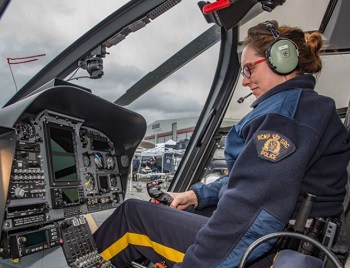
The BC Aviation Council (BCAC) joins the Canadian Business Aviation Association (CBAA) in recognizing and celebrating the women working in aviation and aerospace. (That’s our very own Chair, Heather Bell, in the top right corner of our feature photo – a true champion for diversity in aviation and aerospace!).
Women Of Aviation Worldwide Week (WOAW) is a global aviation awareness week for women and girls of all ages observed to mark the anniversary of the world’s first female pilot licence (March 8, 1910). The week is a call to address gender imbalance in the air and space industry. It is not country or group specific.
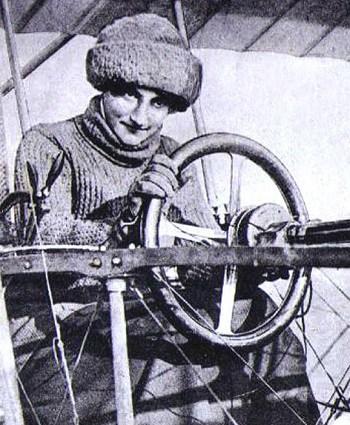
Raymonde de Laroche, Aviatrice
Legacy
It’s thought that the world’s first female pilot license was earned by Raymonde de Laroche, who received her license from the the Aeroclub de France, the world’s first organization to issue pilot licences. Inspired by Wilbur Wright’s 1908 demonstrations of powered flight in Paris and being personally acquainted with several aviators, including artist-turned-aviator Léon Delagrange, de Laroche was determined to take up flying for herself.
In 1913, the Aero-Club of France’s awarded de Laroche the Femina Cup for a non-stop long-distance flight of over 4 hours duration (201 miles/323 km). In 1919, de Laroche set two women’s altitude records, one of which was at 15,700 feet/4,800 meters – an amazing feat considering the technology available at the time. After a long and storied career, a statue of de Laroche was erected at the Paris-Le Bourget Airport to celebrate her pioneering spirit and lifelong commitment to aviation.
 |
 |
 |
Why was Women of Aviation Week created?
When Raymonde de Laroche became the world’s first woman to earn a pilot licence on March 8 1910, she stood as nearly 3% of the commercial pilot population at the time. Her achievement marks the formal entry of women in the air and space industry.
However, until the mid-1960s, the air and space industry actively excluded women. After new anti-discrimination laws stopped the practices, virtually no efforts were made to engage women and girls as viable candidates for the industry’s technical and highest-paying careers.
As a result, while most previously male-dominated industries now count 15% to 25% female participation, the air and space industry does not. In fact, the global percentage of female commercial pilots is still less than 3% today. Likewise, less than 2% of the world’s aircraft maintenance technicians and less than 10% of all working aeronautical engineers are women. What’s more, girls are still 3 times less likely than boys to be introduced to the industry’s hobby and career opportunities.
The Week aims to motivate the industry to assess its current state, celebrate its progresses, and offer to women and girls exclusive opportunities to explore aviation. The ultimate goal is to foster a gender-balanced air and space industry where men and women can thrive in harmony within the next few decades.
 |
 |
 |
How does this affect the aviation and aerospace industry in British Columbia?
According to the Canadian Council for Aviation and Aerospace (CCAA) Labour Market Information Report (March 2018),
“The industry needs to hire 55,000 new workers by 2025 to keep pace with projected growth and replacement demand (retirements and others leaving the workforce). Only a quarter of these needed workers, approximately 14,000, will be filled by domestic graduates from secondary and post-secondary institutions, leaving a requirement to find 41,000 additional workers… The industry continues to be male-dominated with a workforce that is only 30% female, including administrative positions. Occupations with critical shortages have even fewer women, with only 6% of mechanics and 7% of pilots being female… As mentioned previously, women make up only 30% of the aviation and aerospace workforce, whereas they represent 51.2 % of the general workforce.”
By encouraging women and girls towards careers in the aviation and aerospace industry, we help to secure Canada’s place in an industry that is facing numerous challenges in the global economy.
For more information about how you can help encourage young women and girls to consider careers in aviation or aerospace, please visit the Institute for Women Of Aviation Worldwide (iWOAW).
Other helpful links:
The Sky’s No Limit – Girls Fly Too

(News Source: WOAW, with files from Wikipedia, the CBAA, the CCAA, The Sky’s No Limit-Girls Fly Too)